| Common Vietnam Era Military Service Medals Intitled To US Army Vets |


| Army Good Conduct Medal Service: Army Instituted: 1941 Criteria: Exemplary conduct, efficiency and fidelity during three years of active enlisted service with the U.S. Army (1 year during wartime) Devices: Bronze, Silver, Gold Knotted clasp |
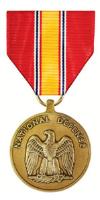

| National Defense Service Medal - NDSM National Defense Service Medal (NDSM) Instituted: 1953 Qualifying Dates: 1950-54 (Korean War period), 1961-74 (Vietnam War Period) , 1990-95 (Persian Gulf War Period), 2001-TBD (War on Terror period) Criteria: 120 consecutive days of service participating in, or any honorable act¬ive duty service during any of the above periods Devices: Bronze Star, Bronze Oak Leaf Cluster Notes: Re-instituted in 1966, 1991 and 2001 for Vietnam, Southwest Asia (Gulf War) and Iraq/Afghanistan actions respectively Overview and History The National Defense Service Medal (NDSM) was initially authorized by executive order on April 22, 1953. It is awarded to members of the U.S. Armed Forces for any honorable active federal service during the Korean War (June 27, 1950 - July 27, 1954), Vietnam War (January 1, 1961- August 14, 1974), Desert Shield/Desert Storm (August 2, 1990 - November 30, 1995) and/or Operations Iraqi Freedom and Enduring Freedom (Afghanistan) (September 11, 2001 to a date TBD). President Bush issued an Executive Order 12776 on October 8, 1991 authorizing award of the medal to all members of the Reserve forces whether or not on active duty during the designated period of the Gulf War. The latest award of the medal was promulgated in a memo, dated April 2, 2002, from the Office of the Deputy Secretary of Defense, Mr. Paul Wolfowitz who authorized the award to all U.S. Service Members on duty on or after September 11, 2001 to a date TBD. Today, there are probably more people authorized this medal than any other award in U.S. history. Circumstances not qualifying as active duty for the purpose of this medal include: (1) Members of the Guard and Reserve on short tours of active duty to fulfill training obligations; (2) Service members on active duty to serve on boards, courts, commissions, and like organizations; (3) Service members on active duty for the sole purpose of undergoing a physical examination; and (4) Service members on active duty for purposes other than extended active duty. Reserve personnel who have received the Armed Forces Expeditionary Medal or the Vietnam Service Medal are eligible for this medal. The National Defense Service Medal (NDSM) is also authorized to those individuals serving as cadets or midshipmen at the Air Force, Army or Naval Academies. The front of the medal shows the American bald eagle with inverted wings standing on a sword and palm branch and contains the words, “NATIONAL DEFENSE”; the reverse has the United States shield amidst an oak leaf and laurel spray. Symbolically, the eagle is the national emblem of the United States, the sword represents the Armed Forces and the palm is symbolic of victory. The reverse contains the shield from the great seal of the United States flanked by a wreath of laurel and oak representing achievement and strength. The ribbon has a broad center stripe of yellow representing high ideals. The red, white and blue stripes represent the national flag. Red for hardiness and valor, white for purity of purpose and blue for perseverance and justice. No more than one medal is awarded to a single individual, but a three-sixteenth inch diameter bronze star denotes an additional award of the medal. |
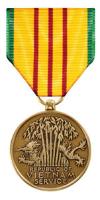
| Vietnam Service Medal Vietnam Service Medal Service: All Services Instituted: 1965 Dates: 1965-73 Vietnam Service Medal Criteria: Service in Vietnam, Laos, Cambodia, or Thailand during the above period. Prior to issuance of this award in November 1965, the Armed Forces Expeditionary Medal was given to those who served in Vietnam. After that period, it is the veteran's choice to exchange the Armed Forces Expeditionary Medal for the Vietnam Service Medal. It is the military's policy that you cannot have two medals to recognize service in the same action. There were 17 campaigns during the Vietnam War. Devices: All Services: Bronze, Silver star; Army: Bronze Arrowhead; Navy: Bronze Marine Corps device The Vietnam Service Medal is often abbreviated VSM on a DD214. Vietnam Service Medal - Overview Authorized by executive order on July 8, 1965 for U.S. military personnel serving in the Vietnam Theater of Operations after July 3, 1965 through March 28, 1973. Personnel must have served in Vietnam on temporary duty for at least 30 consecutive/60 nonconsecutive days or have served in combat with a unit directly supporting a military operation in Southeast Asia. Military personnel serving in Laos, Cambodia or Thailand in direct support of operations in Vietnam are also eligible for this military medal. The Armed Forces Expeditionary Medal was awarded for earlier service in Vietnam from July 1, 1958 to July 3, 1965, inclusive; personnel receiving that award may be awarded the Vietnam Service Medal, but are not authorized both awards for Vietnam service. The front of the medal depicts an oriental dragon behind a grove of bamboo trees; below the base of the trees is the inscription, “REPUBLIC OF VIETNAM SERVICE.” The reverse of the medal depicts a crossbow with a torch through the center and contains the inscription, “UNITED STATES OF AMERICA” along the bottom edge. The colors of the suspension drape and ribbon suggest the flag of the Republic of Vietnam (the red stripes represent the three ancient Vietnamese empires of Tonkin, Annam, and Cochin China) and the green represents the Vietnamese jungle. Bronze and silver stars are authorized to signify participation in any of the 17 designated campaigns during the inclusive period. Designated campaigns for the Vietnam Service Medal are as follows: Army and Naval Services: • Vietnam (VN) Advisory, 1962 - 1965 • VN Defense, 1965 - 1965 • VN Counteroffensive Campaign, 1965 - 1966 • VN Counteroffensive Campaign Phase II, 1966 -1967 • VN Counteroffensive Campaign Phase III, 1967 - 1968 • TET Counteroffensive, 1968 • VN Counteroffensive Campaign Phase IV, 1968 • VN Counteroffensive Campaign Phase V, 1968 • VN Counteroffensive Campaign Phase VI, 1968 - 1969 • TET69 Counteroffensive, 1969 • VN Summer - Fall 1969, 1969 • Vietnam Winter - Spring 1970, 1969 - 1970 • Sanctuary Counteroffensive, 1970 • VN Counteroffensive Campaign Phase VII, 1970 - 1971 • Consolidation I, 1971 • Consolidation II, 1971 - 1972 • Vietnam Cease-Fire Campaign, 1972 - 1973 Air Force: • Vietnam (VN) Advisory, 1961 - 1965 • VN Defense, 1965 - 1966 • VN Air Campaign, 1966 • VN Air Offensive Phase I, 1966 - 1967 • VN Air Offensive Phase II, 1967 - 1968 • VN Air/Ground Campaign, 1968 • VN Air Offensive Phase III, 1968 • VN Air Offensive Phase IV, 1968 - 1969 • TET 69/Counteroffensive, 1969 • VN Summer-Fall, 69, 1969 • VN Winter-Spring, 1969 - 1970 • Sanctuary Counteroffensive, 1970 • Southwest Monsoon, 1970 • Commando Hunt V, 1970 - 1971 • Commando Hunt VI, 1971 • Commando Hunt VII, 1971 - 1972 • Vietnam Cease-Fire, 1972 - 1973 |
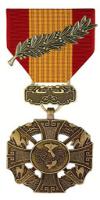
| National Defense Service Medal - NDSM Vietnam (RVN) Gallantry Cross Military Medal Gallantry Cross (Republic of Vietnam) Country: Republic of Vietnam Instituted: 1950 Criteria: Deeds of valor and acts of courage/heroism while fighting the enemy. Devices: Bronze Palm similar to (55), Bronze, Silver, Gold Stars similar to (105) through (107) denote level of award and additional awards. Reflecting her French Colonial heritage, Vietnam’s Gallantry Cross was the direct equivalent of the French Croix de Guerre and rewarded acts of valor or heroic conduct during a conflict with an armed enemy. Although awarded sparingly during the early years of the Vietnam War, the Gallantry Cross was widely bestowed upon RVN troops as a reward for much heroism and peril. Many American service men received the award as a personal decoration or as a unit award. As with the French Croix de Guerre, the emblems worn on the ribbon denoted the level at which the medal was achieved. For an Army or Armed Forces Despatch: a bronze palm; for an Army Corps Despatch: a gilt star; for a Divisional Despatch: a silver star; for a Bri¬gade, Regimental or Unit Despatch: a bronze star. There were no restrictions on the number of devices which could be worn on the ribbon. The medal is a bronze, cross patte with the four arms interconnected by engravings representing two dragons with two crossed sabres between the arms, handles down. In the center is a disk showing the map of Vietnam with a laurel branch on either side and the ribbon across the map inscribed, “Re¬ward of the State” (in Vietnamese characters). The reverse contains the same design except the disk in the center is plain. The suspension is rectangular in shape and depicts two stylized dragons facing one other. The Gallantry Cross also appeared in a second configuration, that of a unit citation. In this format, the ribbon was worn encased in a typical U.S. gold unit award frame. When conferred upon a unit, no medal was awarded but personnel of the U.S. Air Force and Naval Services wore a bronze palm on the unit award ribbon. Army recipients were also awarded the unit citation but all four devices described above were utilized to indicate the size of the cited unit. For more detailed information on Republic of Vietnam awards refer to the book The Decorations and Medals of the Republic of Vietnam and Her Allies, 1950- 1975 by Foster/ Sylvester. |
| Vietnam Campaign Military Medal Service: All Country: Republic of Vietnam Instituted: 1966 Criteria: 6 months service in the Republic of Vietnam between 1961 and 1973 or if wounded, captured or killed in action during the above period. Devices: Silver Date Bar Notes: Bar inscribed “1960” is the only authorized version. Vietnam Campaign Medal - Background The Republic of Vietnam Campaign Medal was established by the Government of the Repub¬lic of Vietnam on May 12, 1964 and authorized for award to members of the United States Armed Forces by the Department of Defense on June 20, 1966. To qualify for award, personnel must meet one of the following requirements: (1) Have served in the Republic of Viet¬nam for 6 months during the period from March 1, 1961 to March 28, 1973. (2) Have served outside the geographical limits of the Republic of Vietnam and con¬tributed direct combat support to the Re¬public of Vietnam and Armed Forces for six months. Such individuals must meet the cri¬teria established for the Armed Forces Ex¬peditionary Medal (Vietnam) or the Vietnam Service Medal, during the period of service required to qualify for the Repub¬lic of Vietnam Campaign Medal. (3) Have served for less than six months and have been wounded by hostile forces, captured by hostile forces, but later escaped, was rescued or released or killed in action. Vietnam Campaign Medal - Special Eligibility Rules Special eligibility rules for the Vietnam Campaign Medal were established for personnel assigned in the Republic of Vietnam on January 28, 1973. To be eligible for the medal, an individual must have served a minimum of 60 days in the Republic of Vietnam as of that date or have completed a minimum of 60 days ser¬vice in the Republic of Vietnam during the period from January 28, 1973 to March 28, 1973, inclusive. The Republic of Vietnam Campaign Military Medal is a white six-pointed star with cut lined, broad gold star points between and a central green disk with a map of Vietnam in silver surmounted with three painted flames in red, signifying the three regions of Vietnam. The reverse contains the inscrip¬tion, “VIET-NAM” in a lined circle in the center with the name of the medal inscribed in Vietnamese text at the upper and lower edges separated by many short lines. The device, an integral part of the award, is a silver ribbon 28mm long on the suspension ribbon and 15mm long on the service bar inscribed, “1960- ” and was evidently intended to include a terminal date for the hostilities. Many examples of this medal are found with de¬vices inscribed with other dates but the only version authorized for U.S. personnel is the one described herein. |